Pages

Showing posts with label Term 2. Show all posts

Thursday, 8 July 2021

Sustainable Fishing - Prezi

 Over the past few weeks in Social Studies, we have been gathering ideas and facts to put into our Prezi presentation. My presentation details are about by-catch, commercial fishing, sustainable fishing, and dolphin-safe labels. Those topics are explained much more in detail in my presentation together with some photos. The facts that are put in the paragraphs came from the research that we did while doing this topic. 

In our presentation, we also had to include different types of sentences and paragraphs. The type of paragraph that I used for my topics is the Lawyer paragraph. I used the lawyer paragraph since it suits the topics. These paragraphs also have to include a minimum of 6 sentences and up to how much you want to write. 

The main topic in my presentation is sustainable fishing. Sustainable fishing is important because it is what determines the ocean's circle of life. It also determines whether another kind of marine species would go extinct which would then cause an unbalance to both the prey and predator's diet. 

Sustainable and seasonal fishing, water at the center of world development  - BCFN Foundation

MY PRESENTATION

(I only placed the link because I didn't know how to embed it.)

Wednesday, 7 July 2021

Greenpeace - Social Studies

 Who and what is Greenpeace?

Greenpeace is a global, non-governmental organization. Greenpeace holds peaceful protests and creative ways of communication to expose global environmental problems. Those ways also allow them to find and give solutions to help improve the difficulties. Greenpeace has offices in over 55 countries around the world. They also have an international coordinating body in Amsterdam, the Netherlands. Greenpeace was found in the year 1971, Irving Stowe and Dorothy Stowe. Both being ex-pat environmental activists. 

What has Greenpeace done to make positive changes?

The Greenpeace organization documents investigate and expose the causes of environmental demolition. Greenpeace always prioritizes dealing with the problems in a calm, peaceful but direct way. The direct actions that they make are physically reacting to immediately stop the wrongdoing happening in the scene.

What are they doing now to help our oceans?

Greenpeace stated that they need all the help that there is to help our oceans. Problems that are making things a little too difficult are natural causes like climate change. That's why getting as many people involved with helping our oceans improve can make the possibility of issues lessen down. Us making a move on improving our oceans now can assure that 30% would be fully protected.  

Resources:


Tuesday, 6 July 2021

Speed Investigation - Science

Aim: To see if any cars are speeding outside our school.

Method: 1. Measure distance... power pole --> power pole = 50 m 
2. Time how long it takes a car to travel the distance. 
-"flag" person indicates when a car passes their pole.
-"timer" person starts when a car passes their pole then stops when the flag person tells them to. 
-"writer" person writes down the times.
3. Collect the times 
4. Calculate speed in m/s --> convert to km/h
5. Are there any speeders?

Result:

Speed

Car1

Car2

Car3

Car4

Car5

Car6

Car7

Car8

Car9

Car10

Average

Time (s)

4.69

3.59

4.50

4.40

5.40 

4.13

6.07

3.77

3.43

5.02

4.504

ms -1

10.6

13.9

11.1

11.3

9.25

12.0

8.21

13.2

14.5

9.96

11.402

km hr-1

38.1

50.0

39.9

40.1

33.3

43.2

29.5

47.5

52.2

35.8

46.01

Conclusion: 

After doing this experiment and seeing all the results, it is noticeable that all the cars that pass our school do not go at the same speed. Some are going slower than the speed limit and some are going a little faster. The reason being is that some are heavy vehicles/trucks, and some are small cars. All the calculations together, the average speed of the cars is 46.01 km/h. That is below the speed limit which means that the road is much safer. 


Friday, 2 July 2021

Wananga Reflection

 Yesterday after school, we celebrated salo-salo with the rest of the Filipino Youth Group; We celebrate salo-salo each year. The event is filled with different cultural dances performed by the students and teachers. That was a really fun experience and such a big milestone since they made it to the news for the Philippines. The performances that were done yesterday were already performed in an event in the city called Indep. The performance was really good and was also satisfying. My favorite one was the Tinikling. They performed it in such a beautiful way and always gave us chills.  It was so far the most beautiful performance I've seen. 


Tuesday, 29 June 2021

Eco Tourism - Social Studies

What is Eco-Tourism? 

Eco-tourism is responsible for traveling to natural areas that conserve the environment. Tourism directed to the exotic frequently threatened natural environment, intended to support the conservation efforts and observe the wildlife. Eco-tourism also minimizes the impact of tourism on the environment, meaning that it boosts financial and employment probabilities for the local people. Eco-tourism is valued since it helps preserve the most beautiful natural surroundings on Earth. Though Eco-tourism is valid, there are still some disadvantages that come with it. Like natural resources being overused and destroyed by making souvenirs. 

Why is Eco-Tourism a growing trend?

Eco-tourism is a growing trend since it doesn't only positively impact the environment but also the locals. Like said earlier, it opens a lot of jobs and financial opportunities for the local people. These would provide them with a lot of benefits and helps them improve their lives. It impacts the environment around them positively; It advances the awareness of protecting the natural habitats and intact environments. This means that different communities around the world would be able to build resources without having to do something that could cause harm to the environment. These could increase tourists counts, them being able to explore the untouched, natural environment. 

How does eco-tourism help our oceans? 

Eco-tourism is a tool to increase the ecological concerns of the locals, meaning that eco-tourism is a valuable way of spreading awareness and creating positive changes in biodiversity; Specifically marine preservation. 


Monday, 28 June 2021

Sustainable Fishing - Social Studies

Let us talk about sustainable fishing nowadays. It is pretty difficult to catch fish sustainably, especially now that we have modern ways to do so. Methods like long lining and purse seining. Though it is not the most sustainable way, it surely is the easiest. Being able to harvest fish sustainably is very important since the ocean's circle of life depends on it. Taking too much of a specific kind of fish or marine life could cause other kinds to overpopulate. Let's go back to one of the modern methods, longlining. Like I said this method is one of the easiest because all you have to do is attach a long line at the back of your boat with hundreds of hooks attached to it. Now from what it sounds, it is not as sustainable. Doing this could result from you catching different species, not the ones you are after. That is called "By-catch". By-catch is marine species, caught by accident. Common ones are whales and dolphins; Affecting them very negatively, especially when they are already in danger of extinction. 
 
One sustainable way of fishing is Spear Fishing. This method is known worldwide and is also used for millennia. This is the most sustainable method since you have to use your own mental and physical strength. You have to target a specific type of marine species and not just go out, throwing spears at random ones. This is also sustainable since you don't ruin the environment. You don't just leave spears around. 

How is commercial fishing a threat to dolphins and birdlife (by-catch)?
Talking about dolphins, they have been severely affected since over 300,000 dolphins are killed EACH year as by-catch. The same goes for birdlife. They get caught by diving for bait then end up getting hooked. 


Sunday, 27 June 2021

"Kasunduan" - English Short Film

 In English, we have been spending the past 4 weeks making a short film. The short film that we made was inspired by the film we learned about at the start of this term, The Merchant of Venice. In the four weeks, we had to do the outline of the plot, where the scenes were going to take place, and the costume we had to wear. The film we made was a retelling of another film that we learned about from the previous term, The Merchant Venice. The scene that we recreated was the court scene, where Shylock was ready to take the one pound of flesh from Antonio after not being able to follow what was written in the treaty. 

We made the remake that two sisters signed a contract where Shiela had to kill her husband and children for her sister. The other sister, Skyler, wanted Shiela to do that because Shiela's husband is not rich and the complete opposite of her. He brings disgrace to their family name. They both decided to talk to their Father, demanding that the agreement should be done and settled. With their Father around them, they were too scared to argue since they still have to be respectful when their Father is around. Skyler showed their Father the evidence of the agreement. Her father agreed to it and Shiela tried to fight back. Father asked his right hand to give him the gun, which he then gave to Shiela. Shiela had to choose between her life or her family's life. Shiela stood up, pointed the gun on her head, ready to pull the trigger. Knowing that when she takes her life, Skyler will kill her family. Her sister started teasing her, telling her to hurry up and pull the trigger already. Shiela suddenly pointed the gun at Skyler then, she pulled the trigger. After Skyler got shot, their father approached Shiela, telling her that she has one day to run away and hide. 

In the film that we made, we used a lot of different camera shots and angles that were provided but we had to add in two more extra. The extra ones that we put into the film are "Over the Shoulder shot" and "Eye level".

Friday, 25 June 2021

Wananga Reflection - Matariki

 For today's lesson in Wananga, we learned about the Matariki. What the 9 stars of Matariki are and what they all mean. We watched a video explaining the Matariki in detail and the meaning behind it. 

The names of the nine stars:

Matariki

Tupuārangi

Waipuna-ā-Rangi

Waitī, Tupuānuku

Ururangi

Waitā

Pōhutukawa

Hiwa-i-te-Rangi.


The Story Of Matariki

In the beginning of time, there was nothing, no earth, sea, or sky just, Te pō,  darkness. In this Te Kore, nothingness, Ranginui the sky father and Papatūānuku the earth mother came to be. They lay together in a tight embrace. Together, they had many children who were all male. The sons lived between them in the darkness. As the children grew up, they wondered what it would be like to live in the light. Tūmatauenga, the fiercest of all the sons, shouted to his brothers, “Let’s kill them!”  The brothers disagreed. Tānemahuta, the god of the forests and birds, had a solution to the problem, “We will push them apart, Ranginui will be in the sky above us and Papatūānuku will stay below us so she remains close.”ongomātāne, the god of cultivated food, tried to push his parents apart. He pushed and pushed with no success. Then Tangaroa, the god of the sea, and Haumia-tike tike, the god of wild food joined him. Together they pushed and pushed but still, their parents would not let go of each other.Eventually, Tāne tried. He placed his shoulders on his mother and his feet on his father and pushed hard for a very long time. Rangi and Papa called out in distress, “Why are you doing this?” 

“Please don’t separate us.”  Tāne continued to push with his strong legs, until finally Rangi and Papa were prised apart.The children were excited to finally have light and space to move. Tāwhirimātea, the god of the wind, was angry about the separation. He could not stand to hear his parents in pain, or to see the tears coming from Ranginui.Tāwhirimātea was so angry that in a rage he threw his eyes up into the sky. 

His eyes are now known as the stars of Matariki.


Friday, 11 June 2021

Wellbeing

 For the past few weeks in Wananga, we have been doing reflections on the three factors in our life that we want to improve. The three factors that I chose were Friendships, School, and Culture. The factor that has improved the most in my opinion was school. I was able to achieve accomplishments that I wasn't able to do. I also feel proud since I can now focus on my work better and not get easily distracted.   

Thursday, 3 June 2021

Shark Finning - Social Studies

 What is Shark Finning?

Shark Finning is a terrible act of removing fins from sharks which are then sold. After removing the fins, the shark will then be thrown back into the water. Being unable to swim due to losing their fins, they would then eventually descend onto the bottom of the ocean, dying slowly and painfully. 

Shark Finning is not only a horrendous act but it also makes a big impact on the economy and environment. It is also one of the main reason why shark's population decrease over time. With that being said, it will be hard for them to also reproduce since sharks have a really low reproductive system. Adding into that information, 73 million sharks are being killed each year just for their fins which is very wrong. 


What is "Shark Fin Soup"? 

Shark fin soup is a Chinese delicacy that was stated to be made 1000 years ago. The ability to be able to eat this rare delicacy can change the privileges you have and also your social standings. If being honest, this dish does not have any taste in it nor any nutritional value. Beef stock or chicken stock are added to the dish to make it have flavor and actually taste like something. 


Friday, 28 May 2021

Book Reflection - Wananga

 The book that I decided to reflect on is the book that we are currently reading in ESOL. The name of the book is Skink Gully. The story is about 3 boys going on a holiday. In the first chapter, it stated that they have just finished school and were ready to go on their summer holiday. Dylan and his dad decided to go to a farm and spend time together. Dylan invited Nimish, his friend, to go with them. In the second chapter, it just stated that they found some evidence from right outside their cabin that someone has been close to them, even go as far as to watch them. Zeb the dog has been sensing that someone has been out there all night, but Dylan and the others just decided to ignore it. This chapter was also called "Bodies" because that was where they found a lot of dead bodies of animals. The first one that they found was brought by Zeb. It was a dead feral cat, which mainly means that it was a wild cat. The next dead body that they found was a body of a dead sheep. The latest chapter that we read was, of course, chapter 3. Not that many things happened in chapter 3 than in chapter 2. All that happened was they found a tail of an Otago Skink, which was rarely seen in the area where they were from. 

Burger Competition - Home Economics

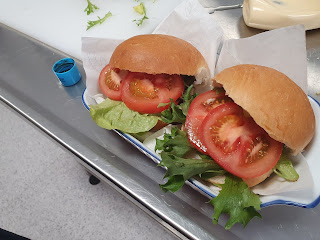
 Last week for Home Economics, we had our burger competition where we competed with other groups from my class. The members of my group are Shiela, Skyler, and Rieya. It has just been announced that we won the "Best Over All Burger" for the competition. 

Evaluation:

  1. How does colour enhance the overall effect of your meals?

The colour of the patty that we made was golden brown, it was the perfect colour and it was also perfectly cooked. We also put mayonnaise, lettuce, and tomatoes which helped add a little more colour to the burger.   


2. What did it taste like?


So far, that was the best-tasting burger we made out of all the other ones we made before. The patty was cooked perfectly, golden brown on the outside, and steaming hot on the inside. It was not raw which was a very big relief for my group since it was a very thick patty. The lettuce and sauces that we put into the burger held everything together.


The comments of the judges made every effort that we put in worth it. They complimented the way the burger was constructed. But they especially mentioned the patty, which was the one that we mainly focused on. The only error that we had was the bottom buns getting soggy after some time. The reason being is that the seeds of the tomatoes were not removed, which caused the juice to fall onto the buns. Next time we do this, we'll remember to not make the same mistakes.


Holiday Trip - ESOL

 Out of all of the holiday trips I went to, my most favorite was when I and my family went to Auckland and Hamilton to visit my grandmother. We went there in 2019 to celebrate Christmas and New Year. The flight only took one hour from Christchurch to Auckland. We arrived there in the afternoon and my grandpa was the one who picked us up from the airport. He's not Filipino that's why I felt a bit shy to talk to him. Fast forward to when we finally arrived at Hamilton, my grandma greeted us with excitement, along with my aunt. That was also the first I saw my Aunt's new dogs named Olaf and Willy. Willy was an outdoor dog that's why he was rarely in the house, unlike Olaf. 

After a few days of spending time together, my aunt invited us to go to Auckland to go to Rainbow's End and to also visit her restaurant. In Rainbow's End, I got to go to the extreme ride which was only available for 2 hours on that day. The ride was called Stratosfear. 

Thursday, 27 May 2021

Corrosion Experiment - Science

Investigating Rusting 

Hypothesis: All of the test tubes will have a corroded nail except for the one in D. 

Aim: To investigate the factors that cause rusting in iron. 

Equipment: 

8 test tubes
Test tube racks 
A bung
8 iron nails
Boiled water 
Tap water
Salty water
Cooking oil
Calcium chloride
Vaseline
Nail polish
Zinc

Method:

1. Label four test tubes A - D and place them in a test tube rack. 

2. Test tube contents: A = Iron nail and tap water, B = Iron nail and salty water, C = Iron nail, boiled water, oil, and D = Iron nail and calcium chloride. Sealed with a bung.

3. Leave the test tube undisturbed for at least three days. 

Test Tube 

A condition present or absent 

Observation after experiment

A

Nail

The nail only rusted at the top and didn’t really look different from how it looked before the experiment took place. 

B

Tap water + Nail

Out of all the other test tubes, B was the one that corroded the most. The whole nail was covered with rust.

C

Salt + Water + Nail 

This test tube was not as bad as the one before. It still rusted but only a little bit. 

D

Oil + Water + Nail 

This nail didn’t corrode as much as the other ones since it was covered with oil, preventing air and water from touching the nail. 

E

CaCl + Bungs + Nail

This nail was the only one that did not corrode out of all the other nails. 

F

Vaseline + Water + Nail 

Same as the one with the oil, this nail didn’t corrode as much because it was covered with vaseline that has the same substance as oil. 

G

Nail Polish + Water + Nail 

This nail corroded and covered the whole nail. When you shake it, the rust just stays on the nail, unlike the other ones when shaken. 

H

Zn + Water + Nail 

With the last test tube, it only corroded the Zn but hardly the nail. There were also tiny pieces of rust floating in the water. 


Experiment followed:


Before Experiment:


Monday, 24 May 2021

The Great Pacific Garbage Patch News Article - Social Studies

Following up with the Great Pacific Garbage Patch blog post, we then needed to make a news article about it. The news article that I created basically includes the facts that I also had put into the slideshow. The only difference is how I presented it. Anyways, I used Canva to create this poster. 


The Great Pacific Garbage Patch - Social Studies

 For our first activity back in Term 2 for Social Studies, we looked at the pollution in the ocean. I found this topic very eye-opening especially for those who aren't really aware of how big of an impact we humans are making. As we all may know, the ocean is the lung of our planet and we're putting it in danger. Plastic pollution is the main one that is causing it to fall apart. The Great Pacific Garbage Patch is a really good example of it. All the marine debris that we're used by fishers gets left out in the ocean which would end up in things called Gyres. Gyres could simply be explained as big whirlpools.

Here is a slideshow that pretty much sums up everything that I said, plus some extra facts about the Great Pacific Garbage Patch: 

Friday, 21 May 2021

Cyberbullying - Wananga

 For today's lesson in Wananga, we talked about Cyberbullying. How it may affect people who are experiencing it and how to get help when experiencing it. We first watched a video that talks about it, how it looks like, and gives people advice on how you can cope with it. Anyways, Cyberbullying or Cyberharrassment is technically bullying but on social media. They use the internet to spread rumors about you or to make fun of you. 

Let's first talk about being a victim of Cyberbullying. It could be really become hard since the bully might be anonymous and you might not really know how you could cope with it. A common thing that they do is send nasty messages to you. The first thing that you should do is take a screenshot of the message that they sent you, block the person, and tell a trusted adult. Show the adult the screenshot that you took and use that as a piece of evidence against the bully. 

Now talking about being the bully. Think about the things that you say before actually saying it. Think about what the person is going through. Think about how it may affect them and their mental health. Just don't do it in the first place. 


Thursday, 20 May 2021

The Star Fish - Social Studies

 For today's lesson in Social Studies, we read a poem as a class. There were just enough people to read out the poem which was very satisfying. Anyways, the message of the poem was that "Something small can make a big difference". At a part of the poem, the man was throwing the starfish that he sees back into the ocean. When someone asked him why he was throwing it all back into the ocean, he said that if he didn't do it, the starfish would actually start to die slowly. He was actually saving the starfish. This is a very good example for us humans too. Even if we just do something small, it may make a big difference. 

THE  STARFISH  POEM

Once upon a time there was a wise man 

who used to go to the ocean 

to do his writing. 

He had a habit of walking 

on the beach 

before he began his work. 

One day he was walking along 

the shore. 

As he looked down the beach, 

he saw a human 

figure moving like a dancer. 

He smiled to himself to think 

of someone who would 

dance to the day. 

So he began to walk faster 

to catch up. 

As he got closer, he saw 

that it was a young man 

and the young man wasn't dancing, 

but instead he was reaching 

down to the shore, 

picking up something 

and very gently throwing it 

into the ocean. 

As he got closer he called out, 

"Good morning! What are you doing?" 

The young man paused, 

looked up and replied, 

"Throwing starfish in the ocean." 

"I guess I should have asked, 

why are you throwing starfish in the ocean?" 

"The sun is up and the tide is going out. 

And if I don't throw them in they'll die." 

"But, young man, don't you realize that 

there are miles and miles of beach 

and starfish all along it. 

You can't possibly make a difference!" 

The young man listened politely. 

Then bent down, picked up another starfish 

and threw it into the sea, 

past the breaking waves and said- 

"It made a difference for that one."